

Many parents are under the mistaken belief that if a parent enjoys being an engineer, for example, that their children will like it too. Parents therefore often encourage their children to follow in their footsteps to pursue the same career path.
It is not accurate however, because thinking style is not genetic.
Every person has his or her own, unique thinking style. There are four main thinking styles: result-, process-, people- or ideas orientated (aka the what-, how-, who- and why- people respectively).
Below are three Thinking Style profiles. The first one is mine, the second is my twin sister’s- and the third one is our niece’s profile. It is evident that despite our relations, our thinking styles differ greatly from one another. As an interesting side note: it is said that often twins’ profiles together make a whole brain profile. It certainly looks like it in our case!
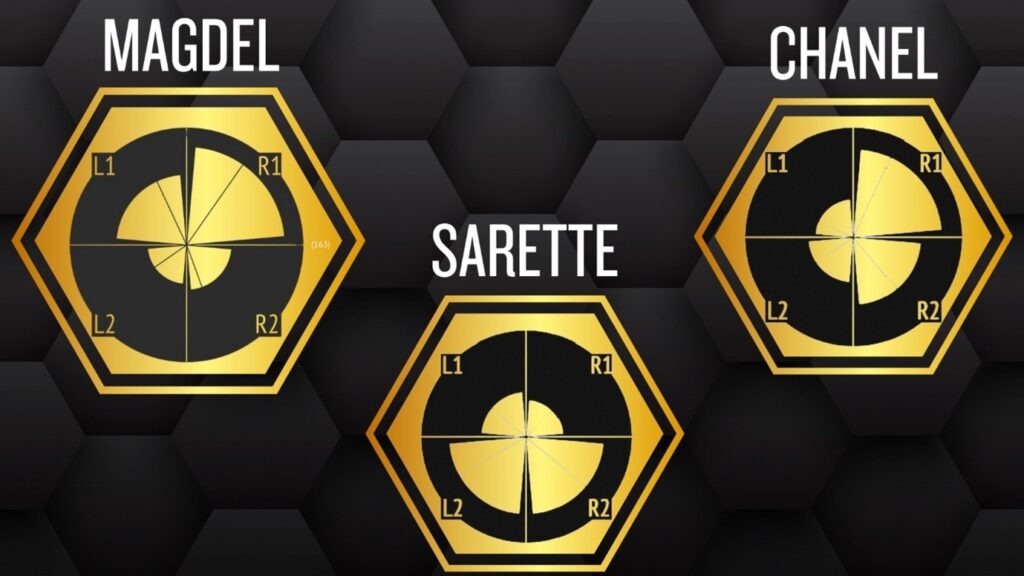
Another misconception is that a person will necessarily like to pursue a subject field if he or she excelled at it at school. Often, especially relating to children who excel in various subjects at school, children are advised that they can pursue any of the subject fields that they excelled at as a career. There is however no relation between being good at something and liking it.
I often use the “”MICE”” system in conjunction with Thinking Style to make suggestions regarding possible suitable careers to a client. “”MICE”” refers to what we are driven by: either Money, Ideology, Coercion or Ego. What drives us is also not genetic. A father may be driven by money but his child may be driven by ideology. It definitely impacts what a suitable career choice would be. For example: people driven by ideology often pursue careers in politics, religion, non- profit organisations etc.
Further factors that distil a suitable career choice are preferences with regards to working environment, uniform, day- or night time work, working inside or outside, reading or writing, speaking or listening, people-, animal- or computer orientated – all of which are unique to each person and not genetic.
A factor that is often taken into account, especially by parents, – but which should rather not be – is status. Children’s natural preferences for certain careers are often dismissed as the specific career choice is not regarded as “”good enough””.

The legendary country singer, songwriter and actor, Kris Kristofferson died recently. His parents were both in the military. He therefore had to enrol in the military. He attained the rank of captain and became a helicopter pilot in the military.
He however yearned to be a singer and he had already written several songs. He had a demo tape and he decided that his best bet of becoming a famous singer, was to hand the tape to the famous Johnny Cash personally. He flew a National Guard helicopter and landed on Johnny Cash’s lawn and he handed him the tape with the now famous song “”Sunday Mornin’ Comin’ Down””, and a beer – which led to a major breakthrough in his career.
He left the military to pursue a career as a singer, songwriter and actor. His parents were livid. They disowner him and did not speak to him for decades, despite his fame and success.
If I had to guess, he was an R1 (conceptual, artistic) dominant thinker. The stereotypical military careers are most often very L2 (structural and process) dominant. I can just imagine Kris’s possible frustration in the military. But WOW! Flying the heli to Johnny Cash is the typical out-of-the-box manoeuvre one can expect from a dominant R1 thinker. That is by far one of the best ways I have heard of how an R1 used an L2 system to his advantage J.
Obviously Kris’s parents did not know that thinking style was not genetic.
Many years ago Kris already requested that the following words had to be written on his tombstone: “”…like a bird on a wire, like a drunk in a midnight choir, I have tried in my way to be free””.
I would like to believe that he lived in his Blisszone as a singer, songwriter and actor and that is my wish for every person!
When Hugh Grant was asked on the Graham Norton Show whether his parents supported his decision to become an actor, he answered: “”Not at all, no””. He proceeded to say that his father was an old soldier and his mother a churchgoing teacher, and that she wanted him to become the archbishop of Canterbury. He further relayed that in “”that world””, show business meant nothing. He referred to a dinner party his mother attended with “”like-minded people”” after the release of the movie “’Four Weddings and a Funeral””, which made Hugh famous. One attendee asked his mother what her two sons did for a living. His mother answered: “”One is an investment banker and the other a film star”” to which the attendee responded: “”Oh how very interesting, which bank?”” Despite Hugh Grant’s fame and fortune, the sadness on his face was visible during this interview.
It is blatantly clear that Hugh’s parents also did not know that thinking style is not genetic. His parents also envisaged that Hugh would choose a career more suitable to the social circles they frequented.
Children yearn for the support and validation from their parents, regardless of their age and success.
I commend the parents who give their children the freedom to express their unique Thinking Style through their chosen careers and who support their children despite their career choices not being what they envisaged. The bottom line is that either a person is working in his or her Blisszone or not.
I accept that every parent wants their child to be successful but the crucial question every parent has to ask, is what does that success entail? Does is only relate to finances or does it include job satisfaction, longevity and quality of life? According to me nothing less than living in their Blisszone should be acceptable!